How do hospitals and clinical labs keep track of all their data?
LabGateway brings together complex information streams for better quality, traceability and productivity
Patrick Ducoroy, Sibylle Collard
Shimadzu Chemistry & Diagnostics
Hospitals and laboratories face increasing pressure to improve productivity, reduce errors, ensure traceability and optimize workflows. Furthermore, they have to efficiently manage the information flows between instrumentation and the Laboratory Information System (LIS), including analytical processing and results. For this reason, it is essential to possess flexible, robust digital technology designed to meet this need: with a seamless interoperability across a range of individual software, reinforcing quality as well as traceability of analyses within the laboratory. High-quality middleware provides the answer – and delivers improvements in quality, traceability and productivity. This is precisely where LabGateway comes in.
In clinical laboratories and hospitals, the volume of data to manage has never been greater. Every sample generates a chain of information: sampling parameters, instrument data, consumables used, intermediate results, validation steps. Added to this are regulatory requirements, deadlines and the need to ensure flawless traceability. In this environment, the challenge is no longer simply a matter of producing reliable analyses, but of tracking and directing an ever-increasing flow of progressively dense and complex information.
LabGateway middleware was designed specifically to address these challenges. Conceived as a true bridge between instruments, information systems and laboratory teams, it offers a structured, fluid and secure approach to clinical data management. Its objective is clear: to enable professionals to focus on their biological expertise while providing them with a tool capable of orchestrating all technical data flows.
Because this issue is such a growing concern for the hospitals and clinical laboratories we all depend on, Shimadzu decided to act. The company was already intimately familiar with the digital complexity and data parameters of their own instruments, so they had a head start on developing a solution.
Here is what Patrick Ducoroy, Managing Director of the Clinical Department at Shimadzu Chemistry & Diagnostics, says: “This software has been developed based on close observation of the field. Our design team, composed of software engineers with over fifteen years of experience working alongside biologists, understands the realities of technical platforms, the constraints of instruments and automats, traceability requirements and productivity challenges. We identified the key issues, including manual multiple re-entries, dispersed data, lack of visibility and complex integrations. And we decided to create a solution able to collect and structure all of that, in order to truly simplify daily operations for everyone involved.”
A plug-and-play software solution that connects the dots
Customizable and scalable
LabGateway middleware offers an automated, customizable and scalable solution for managing and monitoring the entire data and workflows within hospitals and clinical laboratories. It has been developed in such a way that it enables efficient integration into the existing environment. The solution is installed on a server and, thanks to its settings, connections are created between the various systems linked to the laboratory and its activities and modules are activated in order to provide the necessary functionalities for performing and monitoring analyses.



The HL7 Connector enables the generation of HL7 format messages for LIS (Laboratory Information Systems). The module has two operating modes:
• Unidirectional connection: data flows in only one direction
• Bidirectional mode: data flows both ways

The LabGateway HL7 Connector facilitates the sending and receiving of HL7 messages. It can also perform format conversion between device-specific data and HL7 formats, and ensures only the required data is delivered to the LIS system.
LabGateway’s modularity makes it a tool that can be adapted to specific needs, and allows users to add to or complete existing processes within the laboratory.
- BioConnect module: integrates with LIS (Laboratory Information Systems) or LAS (Laboratory Automation Systems) through HL7 connectivity (a bi-directional communication protocol), ensuring communication and data integrity.
- eResults module: supports data interpretation while reducing the risks of manual errors.
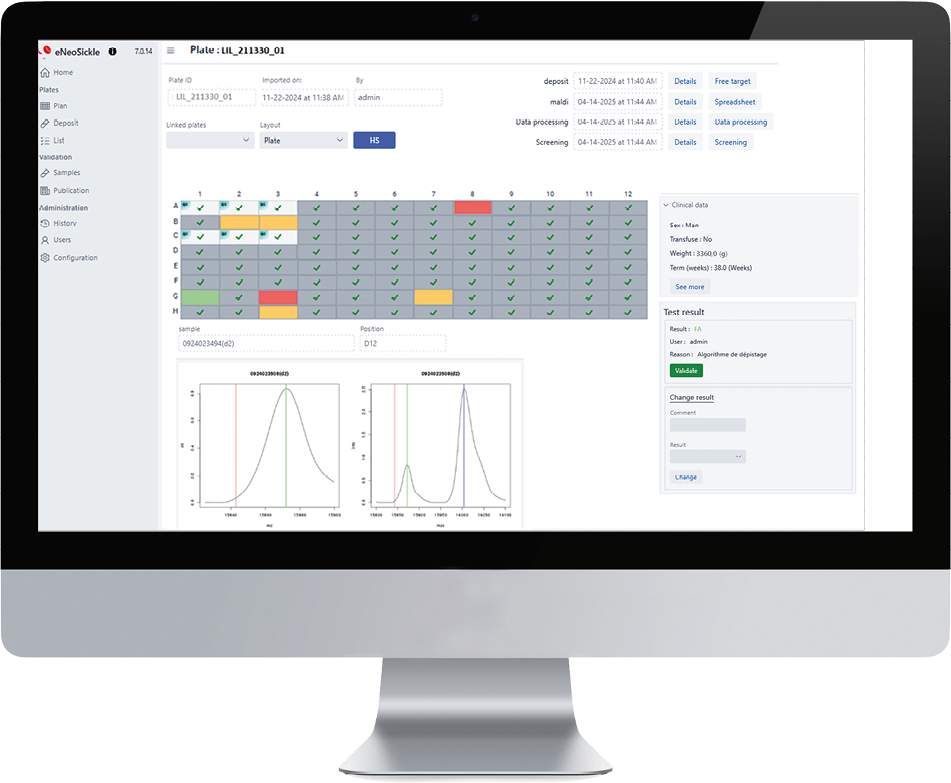
- BioApps module: focuses on specific bio-applications (pathologies such as immunodeficiencies, sickle cell disease, etc.), improving the automated processing of raw data and facilitating the monitoring of pathological sample results.
- Instruments module: facilitates interconnectivity with laboratory instruments (e.g. LC-MS/MS, MALDI) and automation of analysis workflows through drivers.
- Support module: delivers a range of modules to configure and to parameterize the middleware, ensuring the traceability of data from sample to results, including quality control data.
Metaphorically speaking, thanks to a user-friendly interface and easy configuration management (interface, connection, profiles, etc.), LabGateway transcends the term tool and becomes a real partner for hard-working laboratory teams.
Interpretation of multiple pathologies
Moreover, LabGateway allows the management of multiple pathologies within a single laboratory or hospital. Thanks to its BioApps module, the middleware can be used for various biological applications. It adapts and evolves according to laboratory needs and analytical applications, such as sickle cell disease screening or immunosuppressants.
The middleware collects all the information at each stage of the analytical process, and thanks to its optimized interface, the results of the analyses are contextualized and centralized while providing easy access to any data at any time, whether sample results, control quality results or the stability of instrumentation.
Connection with LIS
LabGateway establishes the link between the middleware and laboratory instruments; thus, the LabGateway solution enables the connection with the instrumentation and the Laboratory Information System (LIS) using the HL7 protocol. This functionality provides strong connectivity between the laboratory systems and the LIS, allowing better traceability, automatized transfer of data, decreased manual errors and time savings, ensuring better quality of data.
An optimized traceability at every stage of your clinical analyses
LabGateway also centralizes and organizes all the data collected at every stage of analysis, improving laboratory operation management from samples, quality control and reagents, through instruments and automats, to the analysis and visualization of result data.
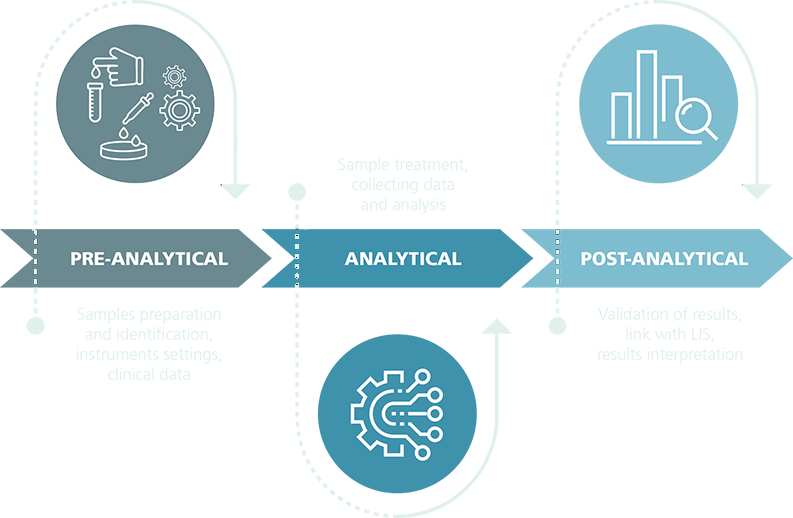
Of particular interest in this context is that LabGateway collects, mostly automatically, the data generated by the instruments, automated equipment and peripheral systems. This reduces or eliminates the need to juggle between multiple interfaces or to manually check for consistency in data. All raw data collected is structured and integrated into a single, consistent flow.
LabGateway ensures the centralized management of all laboratory information. Sample data, results, technical parameters, consumables used, instrument events, etc. are organized in a clear, accessible and usable manner. This centralization reduces errors, improves analytical consistency and strengthens overall process quality.
Focused on traceability and compliance
Traceability is one of LabGateway’s core strengths. Every step, every action, every interaction with an instrument, sample or consumable can be recorded. This provides laboratories with a complete history, which is essential for meeting regulatory requirements, preparing audits or investigating incidents. This transparency reinforces confidence in the results and supports the work of quality teams.
Moreover, LabGateway middleware provides secure storage of all collected data. Information is stored reliably, can be accessed at any time and is organized to facilitate checks, verifications and retrospective analyses.
Beyond all of these functionalities, LabGateway is specifically designed with a pragmatic, field‑oriented approach. It does not impose a single rigid model. Instead, it delivers a built-in ability to adapt to any laboratory’s organization, instruments and workflows. LabGateway quickly becomes a valued co-worker, helping laboratories streamline operations, reduce repetitive tasks and free up time for higher‑value activities.
In a sector where every minute matters and where data quality directly impacts patient care, having a reliable, robust and profession‑focused middleware makes a real difference. LabGateway solution offers a clever and concrete response to the current challenges facing laboratories: managing complexity, increasing efficiency and ensuring seamless traceability.
More than a technical tool, LabGateway is a partner designed to support laboratory teams, strengthen their expertise and enhance overall performance. It is an innovation designed to serve those who work hard to improve science and health every day.