Are your peaks revealing data –
or concealing it?
Dr. Anna Cooper, Shimadzu UK
Expert troubleshooting: Tips for achieving sharper HPLC peaks
Laboratories use ultra-sensitive and highly sophisticated instruments in their work. But these instruments – no matter how technologically advanced they are – are still machines and sometimes act that way. Add to this the fact that lab users are frequently working on method development: using their instruments in new and unique ways in the endless pursuit of better results and meanwhile testing the outer limits of what their instruments can do.
Lab users well know that troubleshooting is a regular part of everyday lab work. And they often reach out to the experts at Shimadzu for advice. This article marks the beginning of a new Secrets of Science series on instrumentation troubleshooting. Specifically, this article explores the prevention and cure of peak shape problems when using high-performance liquid chromatography (HPLC).
Troubleshooting HPLC peak shape issues
Achieving good peak shape is essential for reliable chromatography. The ideal chromatographic peak shape is Gaussian, where the front and tail of the peak are symmetrical. However, in reality this is often not achieved due to a variety of reasons such as secondary interactions or aging stationary phases. The tailing factor, which is a measure of this symmetry, should aim to be between 0.8 and 1.2 to increase the likelihood of resolving peaks of interest and preventing impurities from hiding underneath the peak. Any deviation from expected peak profiles can indicate issues with the system, method or column performance, ultimately affecting resolution, quantitation and data integrity. Because peak shape is influenced by many interconnected factors, troubleshooting requires a systematic approach that considers both hardware and method-related causes. The goal is to ensure sharper peaks – and better data quality.
Common case of peak shape problems
Sample solvent strength
Sample solvent composition plays a significant role in peak shape. Ideally, it should closely match the starting conditions of the chromatographic method to minimize disturbances.
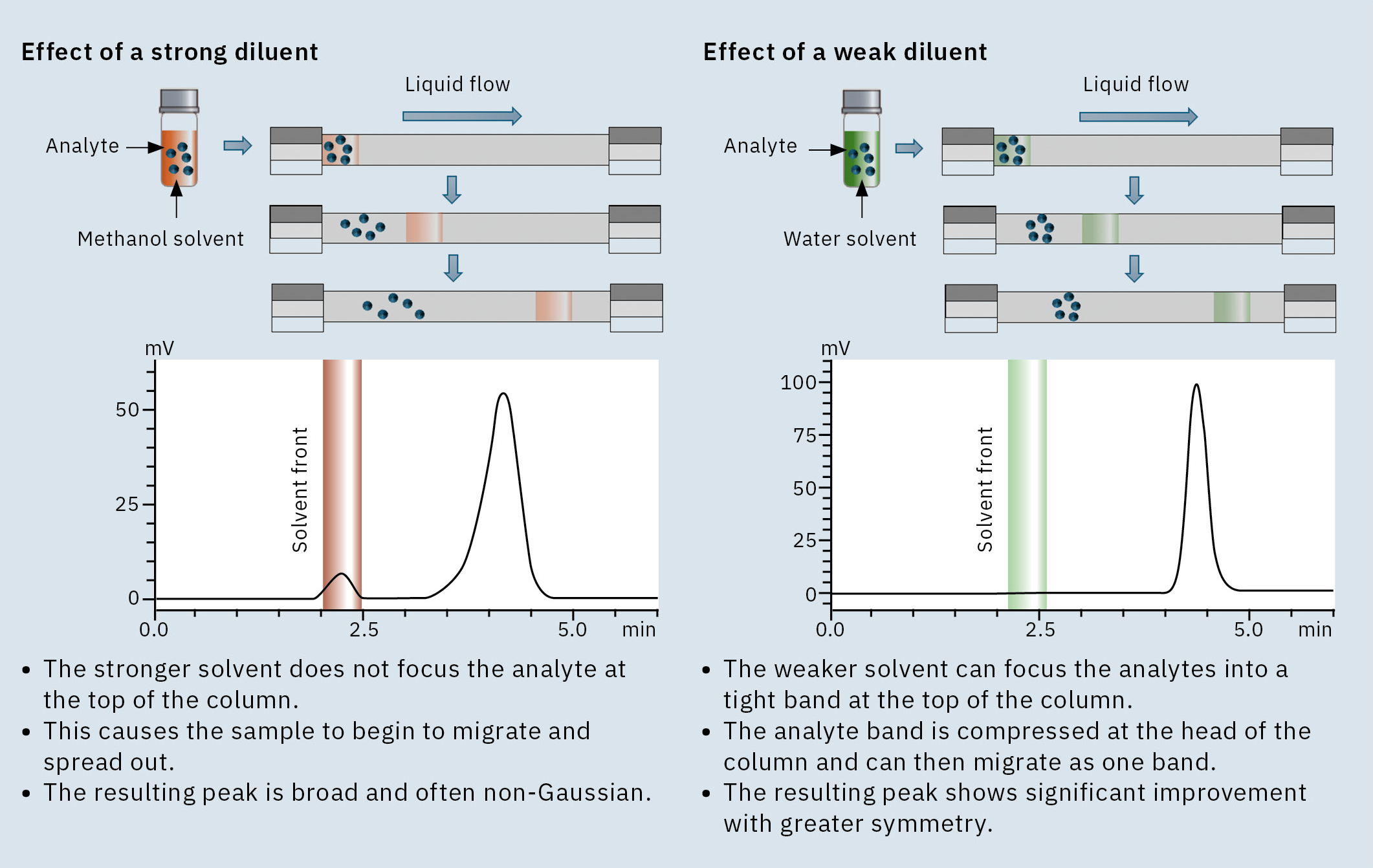
- Weaker solvents (e.g. water in reversed-phase HPLC) can enhance peak sharpness by concentrating analytes at the column head.
- Strong solvents (e.g. 100 % methanol or acetonitrile) risk peak broadening or even splitting, as analytes may be carried along by the solvent rather than being retained effectively. This is particularly problematic for early eluting peaks which experience detrimental peak shape with a strong diluent (Figure 1).
Solutions
- Match the sample solvent to the initial mobile phase wherever possible.
- If the sample cannot be dissolved in a more favorable solvent, a coinjection with water – known as a “sandwich” injection – can be employed. This is where the autosampler is programmed to aspirate a volume of water, then sample, then water again to create a focused sample at the head of the column, thereby negating the adverse band-broadening effects.
Excess injection volume or solvent overload
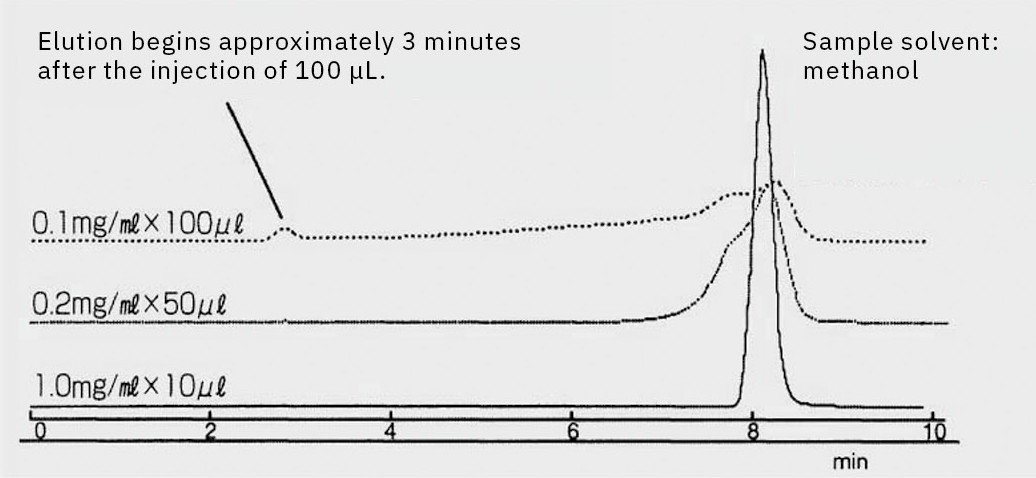
Even with an appropriate solvent, excessive injection volumes distort peaks and reduce efficiency. If too much sample is injected, all active sites at the column head are occupied, and the remaining sample flows past the occupied sites with reduced interaction. Overloading saturates the stationary phase’s active sites – particularly at the column inlet – resulting in peak fronting or tailing, depending on the analyte.
Additionally, column overloading can shift retention times and broaden peaks. This is particularly critical during scale-up: A compound that is well-resolved under analytical conditions may shift and broaden under overloaded preparative conditions, potentially causing smaller impurity peaks to coelute and remain undetected.
If high injection volumes are unavoidable, consider using a column with a larger inner diameter or higher loading capacity to minimize these effects (Figure 2).
Solutions
- Reduce injection volume if sensitivity permits.
- Concentrate samples to allow smaller injection volumes without compromising detection.
- Use columns with higher loading capacities or larger internal diameters if high-volume injections are unavoidable.

Data acquisition rates and detector settings
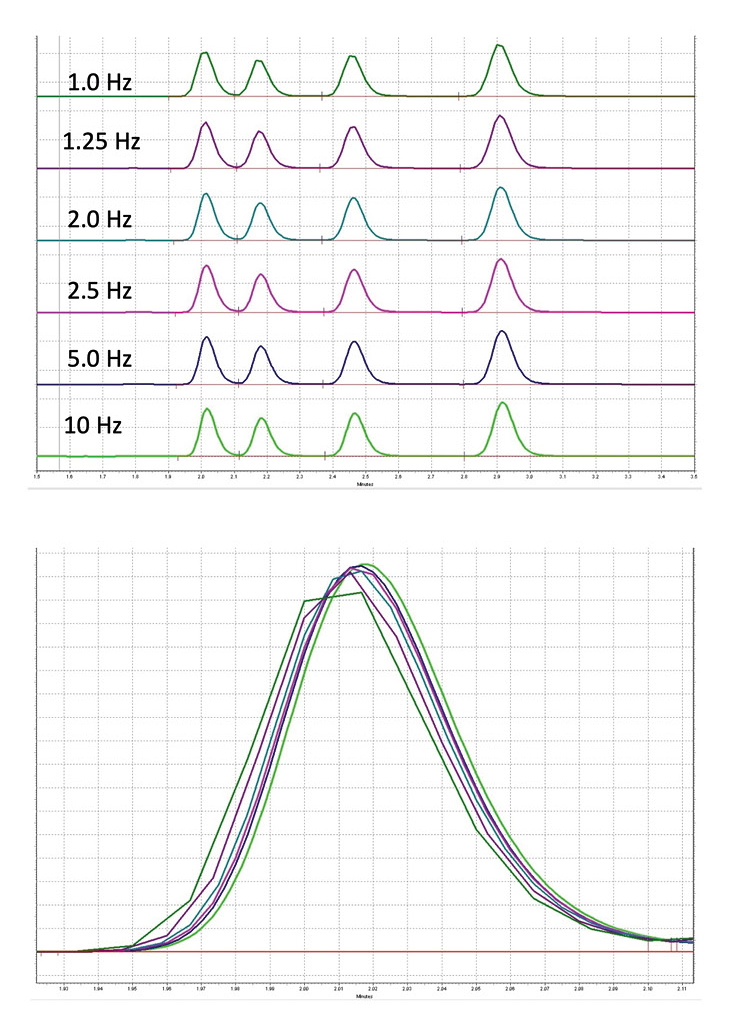
A frequently overlooked factor in chromatography is the data acquisition rate, which significantly impacts the chromatogram quality. It is essential to adjust the acquisition rate to suit the specific chromatography method. This adjustment affects not only the appearance of the chromatogram but also the accuracy of the data.
Peaks measured with a low data acquisition rate are inadequately described due to an insufficient number of data points. This can result in significant fluctuations in peak area, as slight variations may prevent any data point from capturing the true peak maximum. Conversely, an excessively high data acquisition rate can also have drawbacks, such as increased noise levels, which may obscure smaller peaks or reduce overall signal clarity, as well as result in significantly large data files.
At first glance, the peaks in the image on the upper right may appear nearly identical, despite being measured with different data acquisition rates. However, when the chromatograms are overlaid and the section is enlarged, as shown in the image on the lower right, the differences become evident (Figure 3).
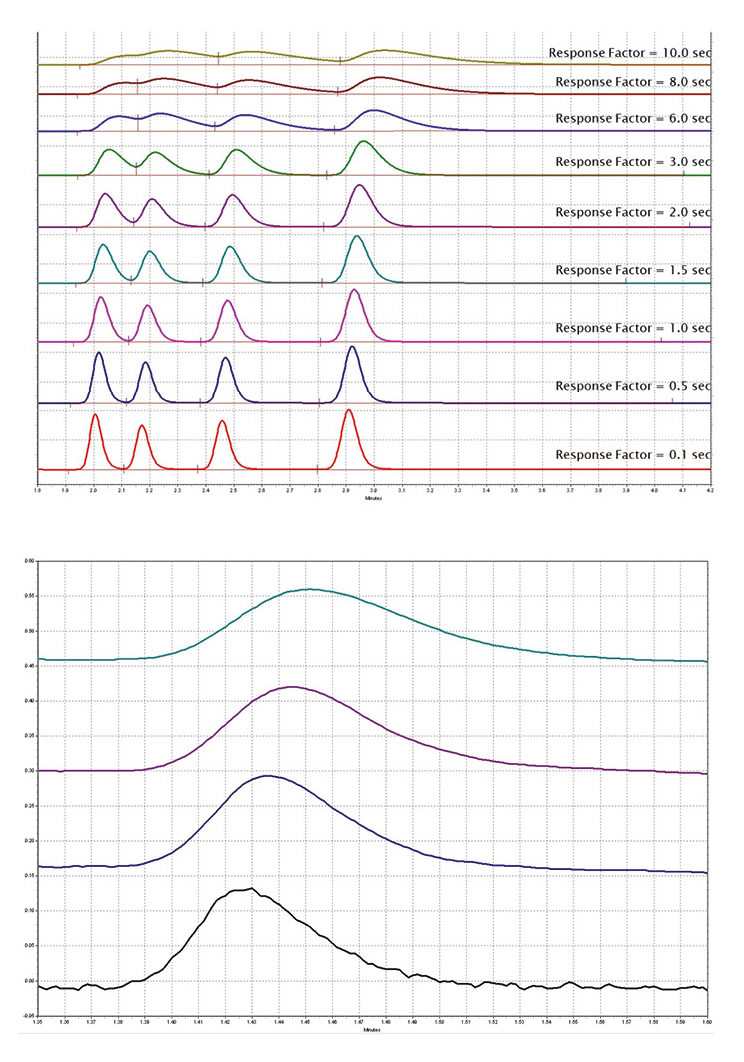
Another parameter is the detector’s response setting. If the response is set too high, peaks are artificially broadened, reducing resolution. On the other hand, setting the response too low narrows the peaks but amplifies noise (Figure 4).
Solution: Use the fastest acquisition rate and shortest response time that still maintains an acceptable signal-to-noise ratio. Optimize these settings during method development rather than relying on default instrument parameters. UHPLC methods require a higher acquisition rate in order to describe the peaks accurately. This is generally above 12.5 Hz.
Practical solutions for specific peak shape problems
Peak trailing
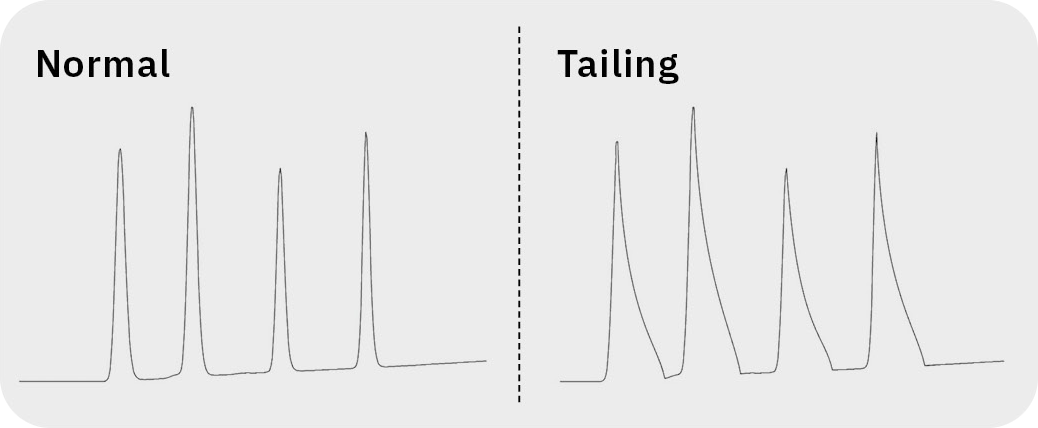
One of the most common peak shape changes is tailing, where the back half of the peak is broader than the front, and trails and elongates the peak. This is often caused by the analyte having more than one mechanism of retention on the column.
In reversed-phase chromatography, the main mode of analyte retention is through hydrophobic interactions, however, so there are often synergistic mechanisms within the column. For example, for ionized basic compounds, the positive charge can interact with the free silanol groups on the silica, which can lead to tailing. As silanol groups are acidic, it’s possible to minimize interactions with the analyte by lowering the pH of the chromatographic conditions. If that isn’t possible, try replacing the column with a deactivated column such as a polymer column, one with good endcapping or a column with a slightly positive character surface. Some column manufacturers (e.g. Shimadzu) offer special columns for the analysis of strongly basic substances.
A damaged column or incorrect analysis conditions, such as an incorrect pH value of the mobile phase, can also lead to tailing (Figure 5).
Fixes
- Lower the mobile phase pH to suppress silanol activity.
- Switch to endcapped or polymer-based columns designed to minimize silanol interactions.
- Check that pH and mobile phase conditions fall within column specifications.
- Increase the ionic strength of the buffer to reduce silanophilic interactions.
Peak fronting
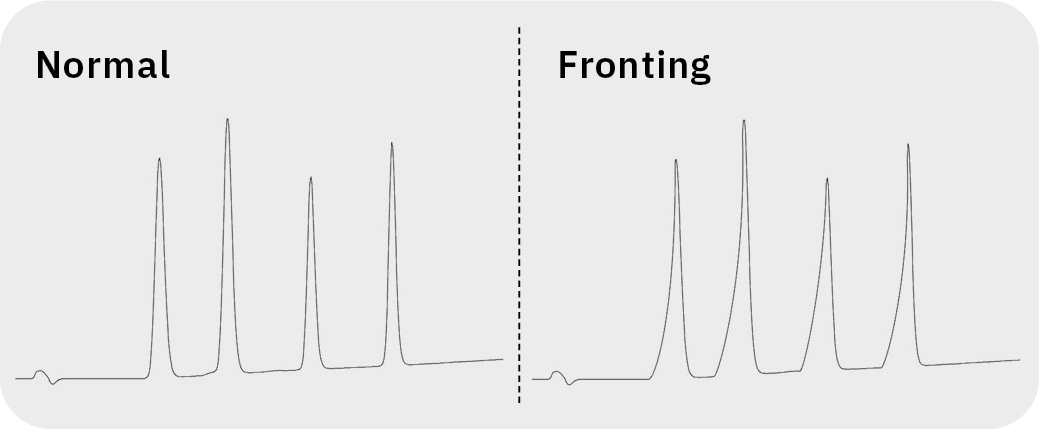
Fronting refers to the opposite asymmetry of the peak found in tailing, where the leading edge is broader than the tail, and looks similar to a shark fin. If fronting gradually increases, in most cases a defective column is the cause. The stationary phase can be damaged due to normal aging or operating the column outside the specifications (e.g. of temperature or pH). In this case, only replacing the column and adjusting the chromatographic conditions will help.
However, as discussed earlier, column overloading can also cause fronting. Reducing injection volume or using a higher-capacity column are key fixes.
Another cause of peak fronting can be an incompatible sample solvent or poor sample solubility with the mobile phase. In this case, only changing the sample solvent will help. A too low column temperature can also cause fronting (Figure 6).
Fixes
- Reduce sample load.
- Use a higher-capacity column, if possible.
- Ensure good solvent compatibility.
- Verify temperature control.
- If fronting worsens gradually, column aging may be to blame: Replacement is usually the only remedy.
Peak broadening
In isocratic separations, it is expected that as the analyte band migrates down the column bed, the band will broaden as a function of resident time in the column. This results in broader peaks for later eluting compounds. This is one of the driving factors for ensuring the analyte has sufficient interaction with the stationary phase but elutes within a reasonable time frame to prevent the detrimental effects of band broadening.
In gradient chromatography, the peaks should all have the same peak width, as the changing composition of the mobile phase compresses the band. If there is an unexpected change in peak width in gradient chromatography, this is often the result of a degrading column which needs to be replaced.
Broad peaks compromise resolution and sensitivity, especially for late-eluting compounds in isocratic separations. As already mentioned, a detector response that’s set too high can contribute to peak broadening. It’s also important to remember that normal column aging is a common cause.
If peak broadening occurs due to dispersion in the injection valve, a “sandwich injection” with small air bubbles can help reduce this effect. Another cause of dispersion can be due to the use of capillaries with an excessively large diameter, or the unintentional introduction of dead volume due to improperly tightened connections.
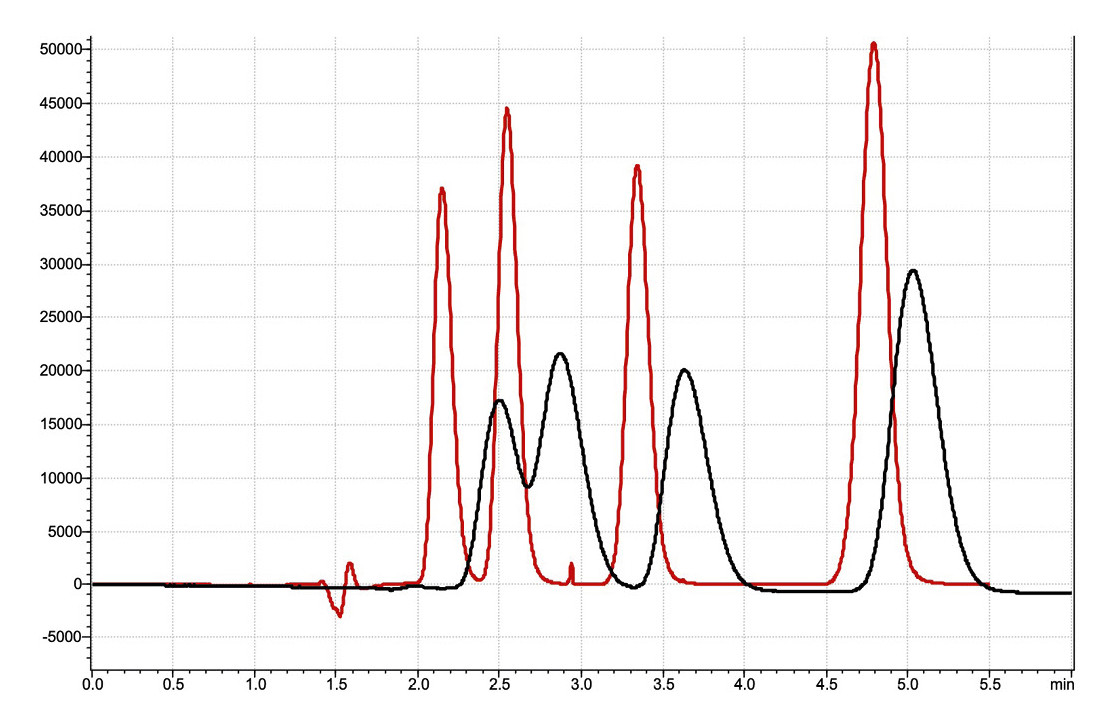
Look what happens in the chromatograph below when a wider, 0.5-mm ID capillary is used instead of a 0.125-mm ID: Baseline separation is lost, and the peaks have broadened. However, also note that narrower capillaries can generate higher back pressures in the system. Therefore, adjust the dimensions of the capillaries to the chromatographic system so that the limits of the permissible pressure maxima are not reached (Figure 7).

0.5-mm ID (black) capillary instead of 0.125-mm ID (red) between column and detector
Fixes
- Inspect and retighten fittings and minimize dead volume.
- Use capillaries appropriate to the flow rates (avoid unnecessarily wide IDs).
- Preheat the mobile phase and use a column oven to maintain uniform temperature.
- Switch to gradient elution to reduce natural diffusion effects for late peaks.
A summary of practical guidelines to prevent peak shape issues
- Match sample solvent composition to initial mobile phase conditions.
- Use injection volumes appropriate for the column capacity.
- Optimize detector acquisition rate and response time for the method.
- Handle columns carefully and adhere to their specifications (pH, temperature).
- Minimize system volume and verify all fittings after any hardware changes.
- Preheat mobile phases to avoid internal temperature gradients.
Troubleshooting together
Changes in peak shape often serve as early warning signs of system, column or method issues. Gradual changes usually point to column aging, while sudden distortions often arise from hardware faults or procedural errors. By addressing solvent effects, injection technique, detector parameters and mechanical factors systematically, most peak shape problems can be diagnosed and corrected quickly.
Effective troubleshooting depends on observation, comparison with reference data and methodical elimination of potential causes – ultimately restoring sharp, symmetrical peaks and reliable chromatographic performance.
It also helps to share experiences, challenges and solutions, and that’s exactly what this new series of articles is all about. When lab users ask, Shimadzu listens. Because while lab work may seem solitary at times, it is also part of a vast community of inquiring minds who every day create fertile new fields of beneficial knowledge. Troubleshooting is just part of the journey, and it is good to remember that no one needs to travel alone.